THIS IS NOW JUST A FEED OF LINKS TO MY BRAZILIAN FOOTBALL FEATURES – FOR OTHER WORK, SEE MY TWITTER FEED

Thursday, 18 April 2013

Against all odds: São Paulo channel horror film alter ego to progress in Libertadores

São Paulo FC needed a miracle. Two miracles, actually. With one game remaining in Group 3 of the Copa Libertadores, the Tricolor were all but eliminated, requiring a win against Atlético Mineiro to stand a chance of sneaking into the knockout stages. Even a victory wouldn't guarantee anything: they also needed a favour from Arsenal de Sarandí, who hosted Bolivian side The Strongest.

Keeping up their own half of the bargain looked the hardest part. Atlético went into yesterday's match at the Morumbi with a 100 per cent record in the competition, having scored 16 goals in their opening five matches. Led by a rejuvenated Ronaldinho, they have reaped the rewards of having a settled, balanced starting XI, on which coach Cuca, himself in the midst of a career renaissance, has been working for well over a year.


To make matters worse, São Paulo were beset by selection issues. Luís Fabiano was suspended for the millionth time since his return to Brazil, as was Jádson, the player whose understated performances lifted the side to last season's Copa Sul-Americana. In came the bustling Aloísio and Douglas. The latter, a full-back by trade, was asked to play on the right of an attacking quartet – a clear sign that coach Ney Franco has yet to fill the hole left by Lucas since the latter left for Paris Saint-Germain.

Atlético were expected to relish the chance to dump the Tricolor out of the competition but Cuca's team selection suggested a more cautious approach: Serginho started in place of the far more attacking Diego Tardelli. That lack of ambition was reflected in a performance that had very little in common with their previous outings in the competition. Simply put, their hearts weren't really in it. Ronaldinho even admitted as such to reporters at half-time, calling it a "big training session".

That São Paulo hadn't scored by that stage owed more to luck than judgement. The hosts, spurred on rather than daunted by the difficulty of the task at hand, produced their best display of the competition so far. Denílson and Wellington snuffed out the threat of Ronaldinho. Douglas and Osvaldo probed the channels, forcing Atlético full-backs Richarlyson and Marcos Rocha – usually such reliable outlets for the Galo – back into their own half. Paulo Henrique Ganso, a player whose star has waxed and waned over the last two years, put in his best performance in a São Paulo shirt, protecting the ball and ushering team-mates forward with his languid passing.

By the time the second half began, the Tricolor knew that their fate was in their own hands; Arsenal had taken the lead against The Strongest. Urged forward by an uncommonly raucous Morumbi crowd, São Paulo dug deep and soon got their reward. Aloísio was felled by Leonardo Silva in the area, allowing goalkeeper Rogério Ceni to stroke home from the spot. The veteran, who continues to divide opinion ("the Margaret Thatcher of Brazilian football", as one Tweeter recently put it) sunk to his knees in celebration of his 110th career goal. Few have been more vital.

Atlético didn't fight back, instead allowing São Paulo to score a second. Ganso's heart-stopping through-ball (how long I've waited to use a sentence like that again) released Osvaldo, whose cut-back was turned home coolly by substitute Ademílson. Game over.


As injury time began, news filtered through that Arsenal had indeed won in Sarandí. Against all odds, São Paulo were back from the brink. It's not the first time they've cheated fate: when the Tricolor won the Brasileirão in 2006, everyone expected it to be a one-off, but they came back to win it the following year – and the year after that. In so doing, they earnt the nickname 'Jason', after the antagonist from the Friday the 13th films. Like the masked killer, goes the logic, they just won't die.

Atlético's lax approach, meanwhile, could quickly come back to haunt them. The fixtures for the round of 16 are decided not through a draw but by a seeding process: the team with the best record from the group stage plays the team with the worst, and so on. Atlético had already qualified as first seeds. The team that qualified with the lowest points tally turned out to be... São Paulo. "[Ronaldinho] can play how he wants," remarked Ceni, pointedly. "Next time it counts."

When the sequel comes around they may live to regret not putting the final nail in São Paulo's coffin. In Brazilian football, as in horror films, you write off Jason at your peril.


A version of this article was published by The Guardian.

(Photo credit: Tom Dib, LancePress.)

Tuesday, 9 April 2013

The week(end) that was - #5

Reborn Uruguayans, dressing room pacts, stories of redemption and mysterious masked fans: all in a few days' work for Brazilian football. Here are the stories of the weekend...


Lodeiro stakes his claim

Leggy forward Vitinho caught the eye in Botafogo's 3-0 win over Olária, climbing off the bench to score two fabulous goals in the final stages. But the game's true standout performer was Nicolás Lodeiro. With Clarence Seedorf given the evening off by Oswaldo de Oliveira, the Uruguayan made the most of a rare chance to assume centre stage, buzzing around nefariously behind the forwards and threatening with his dead-ball delivery. 

His goal, which arrived just after the interval, was a thing of beauty. Seizing upon a defensive slip-up, he surged towards the edge of the penalty area before cutting back onto his favoured left foot. With goalkeeper and centre-back (reasonably) expecting a shot, he then shifted the ball back to his right, taking them out of the game completely before clipping into the empty net. It was the kind of subtle, intelligent play that earnt him a move to Ajax as a 20-year-old and a place in Uruguay's 2010 World Cup squad. Botafogo may not be where he imagined himself playing at the age of 24, but the signs are that he's coming into his own in Brazil.

Público zero (almost)

Vasco da Gama's game against Friburguense on Sunday was played out in front of just paying 546 spectators at the São Januário. But this wasn't just another example of the occasionally fair-weather nature of Brazilian fandom. Rather, it was the result of a protest by the club's supporters' groups at the chaotic administration of president Roberto Dinamite. Barely a week seems to go by at Vasco without infighting or financial mismanagement coming to light, prompting the influential Força Jovem group to call for público zero this weekend. 

A few hundred picket-line crossers diminished the force of the protest slightly, but the presence of fans outside the stadium before kick-off was enough to dissuade Dinamite from attending. The anger is entirely understandable but Vasco fans must be careful what they wish for; portions of the crowd were calling for the return of Eurico Miranda, a man most famous for his and callous reaction to a stadium accident that left over 150 people injured at a Vasco match in 2000.*

(Another curiosity at the São Januário was the reappearance of the creepily-masked supporter known as Mister M. Could Mister M have anything to do with Mr Miranda? Conspiracy theories abound.)

Palmeiras pact pays off

Last month's 6-2 mauling at the hands of minnows Mirassol was always likely to go down as a key moment in Palmeiras' season. After the travails of 2012 and unedifying (read: despicable) scuffles between idiotic fans and players in March, you would have been forgiven for expecting total meltdown as the club prepares for life in Série B.

But things have panned out rather differently. Coach Gilson Kleina kept his job and has led the Verdão to three consecutive wins. This weekend a goal from in-form Leandro (who also scored on debut for Brazil in the non-event friendly with Bolivia just 24 hours earlier) saw them condemn early-season flyers Ponte Preta to their first defeat in 17 Paulistão games.

The key to this turnaround? Crisis talks in the dressing room following the Mirassol match. "We made a pact to overcome adversity," said defender Wendel. Fluffy-haired creator Tiago Real chimed in: "We said that we had to start from scratch. The results show that we've done that." These remain early days, but one senses that better times lie ahead for Palmeiras.


Fonte Nova opens with a bang

Another of Brazil's World Cup stadiums was unveiled on Sunday, when the Arena Fonte Nova in Salvador hosted the Campeonato Baiano game between Bahia and Vitória. The 55,000-seat stadium, built as a replacement for the Estádio Octávio Mangabeira, will host six games in 2014, as well as three at this summer's Confederations Cup. 

No serious issues were reported at the inauguration, meaning fans were able to fully enjoy the Ba-Vi, one of Brazil's most historic clássicos. Not that 'enjoy' was the right word for Bahia fans, who watched their side slump to a galling 5-1 defeat at the hands of the Ruby-and-Blacks. Among the scorers for Vitória was Maxi Biancucchi, the cousin of one Lionel Messi. Brazilians will be hoping that success doesn't run in the family if Argentina show up at the Fonte Nova in 2014.

Redemption for Rhayner

There are dry spells and then there are dry spells. Just ask Fluminense forward Rhayner. Before this weekend the 22-year-old had failed to register for the Tricolor, whom he joined at the start of the year. That would have be fine, except for the fact that he hadn't managed to find the net in 34 games for former club Náutico either. And for the three clubs he represented before them (Figueirense, Linense, Tombense)? You guessed it: zero goals. His last strike had come back in January 2011.

It wasn't for lack of trying; Rhayner did well enough at Náutico to earn a move to Flu, and had been lively in the latter's early Campeonato Carioca games. When the reigning Brazilian champions were awarded a penalty against Macaé last month, there was only one logical candidate to take it. Rhayner duly missed.

So when the youngster fortuitously found the net with a cross-shot against Resende on Saturday, the relief was almost palpable. After two years and 83 games without a goal, even a subsequent injury couldn't quite take the smile off his face; he left the pitch visibly buoyed by the cheers of the crowd at the Raulino de Oliveira stadium. Perhaps now the floodgates will open.


*For more on this story, read chapter thirteen of Alex Bellos' excellent Futebol.

A version of this article was published by The Guardian here.

(Photo credits: (1) Paulo Sergio, (2) Vanderlei Almeida/AFP.)

Saturday, 6 April 2013

Brazilian football digest: March

In my latest monthly round-up for Betting Expert, I discuss Hernanes' influence on the Brazil side, the embarrassing closure of the Engenhão and Mirassol's stunning 6-2 victory over Palmeiras. I also pick out my goal of the month from March.


Read the article here.

Friday, 22 March 2013

Draw against Italy gives Brazil something to build upon

It is, of course, folly to read too much into international friendlies, particularly those that precede an important competitive game for one of the teams involved. For Brazil, though, there is no other litmus test; new (old) coach Luiz Felipe Scolari must plot a path to World Cup success using only these most untrustworthy waypoints.

There were plenty of positives to be drawn from Thursday's 2-2 draw with Italy in Geneva. The performance of Lazio midfielder Hernanes, in particular, was reassuring – not least to those convinced that his inclusion would signal a sea change for the seleção. Rather than being marooned out wide as he had been on previous outings for Brazil, Hernanes operated deep in midfield, setting the tempo with his lucid decision making and two-footed passing. The formula is fairly simple: if you can kick with both feet you often have twice as many options in crowded central areas.


Alongside him, Grêmio youngster Fernando didn't look overawed on debut. Powerful and intuitive, he has a promising future at this level, particularly if Scolari's doubts over the defensive prowess of Ramires and Paulinho persist. Filipe Luís was also quietly effective, while Júlio César took another huge step towards (re)establishing himself as Brazil's first-choice goalkeeper.

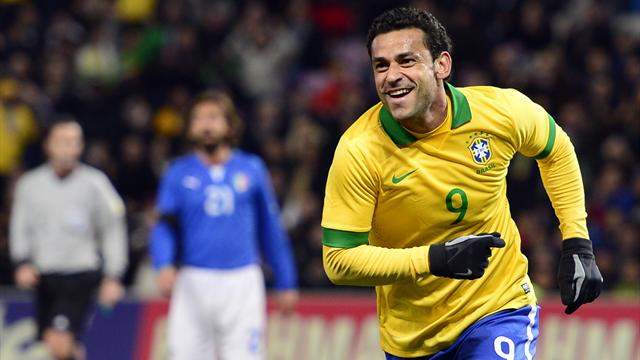
Neymar, stationed just behind Fred in attack, shone in spells and created Brazil's second goal with a shimmering run. Yet it was his pressing and positioning that drew plaudits from Scolari. "Tactically, that was one of the best performances I've ever seen from him," gushed the 64-year-old. "He was perfect."

Elsewhere, the outlook was far less positive. Daniel Alves was characteristically busy but suspect in defence, meaning that David Luiz – who captained Brazil on the night – was often called upon to pitch in as Italy attacked down the left. For all his abundant talents, Luiz is the kind of player that needs to be focusing on his own job rather than bailing out his right-back. As a result, Dante, a big hit at Bayern Munich this term, looked less assured than he did against England at Wembley.

And then there was Hulk. Not-so-incredible Hulk. The Zenit St Petersburg forward started on the right but was quickly shifted to the opposite flank as Scolari sought to counteract Christian Maggio's bounding forward runs. That ploy was partly successful but completely negated the influence of Brazil's number seven, who looks lost when unable to cut in onto his left foot. His miscontrol when well placed in the second half owed plenty to a poor pitch in Geneva but was also indicative of his general malaise. Many in Brazil remain unconvinced of his ability to perform at international level.

In some respects, Scolari can be thankful for Italy's second half reaction, which should ensure that nobody gets carried away the modest successes of the opening period. And while the seleção were second best for long periods, a draw is a foundation upon which Felipão can reasonably hope to build. It was, as Estadão columnist Artero Greco put it, "A fair result. Particularly for Brazil."

(Photo credit: Getty.)

Saturday, 16 March 2013

Five questions for Brazil ahead of Italy and Russia games

Luiz Felipe Scolari's second spell in charge of the seleção began with a whimper, with his side limping to an anodyne loss to England at Wembley in February. Felipão doesn't have to wait too long for a chance to make amends, however: Brazil face Italy and Russia in the next fortnight as the Neverending Friendlies series rolls on.


Ahead of those games, I've picked out five stories to keep an eye on. Will Neymar bounce back? Can Kaká become more than a stop-gap? Will David Luiz grace us with his saintly presence? Find out in my latest Unibet column.

Thursday, 7 March 2013

Will incidents prompt Brazil to tackle stadium ills?

Three incidents since the turn of the year – one of which resulted in the death of a young fan – have provided renewed cause for concern over fan behaviour and the stadium-going experience in Brazil. First came the collapse of a barrier during a Grêmio match, which left eight people requiring medical attention. Just four days later, fans reported a series of issues at the reopening of the Mineirão in Belo Horizonte.


Yet these problems seem insignificant next to the death of a 14-year-old supporter during the Libertadores match between San José and Corinthians, a tragedy that raised questions over the behaviour of Brazil's torcidas organizadas (supporters' groups) and their links to clubs themselves.

In my latest piece for ESPN FC, I reflect on these incidents – and the lessons that Brazil must draw from them.

(Photo credit: EduAndrade/LatinContent/Getty Images.)

Monday, 4 March 2013

The week(end) that was - #4

It has been a fine few days for Diego Forlán, whose goalscoring exploits have played a major part in Internacional's strong start to the year. Neymar and Abel Braga had rather less enjoyable weeks, however...


Forlán's class begins to show

Diego Forlán did not enjoy the most fruitful start to his career in Brazil, struggling to make his mark in an Internacional side that had a year to forget in 2012. But the early signs are that the current campaign will be rather kinder to the Uruguayan. His fine double against Esportivo at the weekend took him to six goals for the season and earnt Inter a place in the final of the Taça Piratini – the opening stage of the Rio Grande do Sul state championship. Forlán also netted in the quarter-final against bitter rivals Grêmio.

The 33-year-old has benefitted greatly from the seriousness with which Inter have treated the Gauchão. While Grêmio have been content to play reserve sides and preserve their stars for the Copa Libertadores, the Colorado have put pedal to the metal in an attempt to kickstart a year that they hope will be crowned with a major title. As a result, Forlán has enjoyed plenty of game time alongside Leandro Damião, with whom he is beginning to form a tidy partnership: the pair have bagged nine of the 12 goals scored by Dunga's first-choice XI in 2013. If they can take that form into the Brasileirão, Inter could finally mount a serious title challenge.


Lighten up, Abel

Vasco da Gama beat Fluminense on Saturday to reach the final of the first half of the Campeonato Carioca (keep up at the back!). This was less a game of two halves than one of four quarters, which played out like a Mogwai song: quiet-quiet-quiet-LOUDER-THAN-BOMBS. The game was goalless going into the closing stages, only for five goals – spread over two comebacks – to hit fans at the Engenhão like a flurry of punches. (A poor cameraman, incidentally, was probably the only one nursing actual bruises, after getting knocked to the ground by an over-jubilant Bernardo.)

In the post-match press conference Fluminense boss Abel Braga could have sounded off about his side's defending, but chose instead to hit out at Vasco substitute Dakson (yes, really) for having the impudence to back-heel the ball to a team-mate in the dying minutes. This wasn't a case of the youngster just playing to the gallery – the pass set up a promising attack – but even that would hardly be a crime. Braga, as Estadão columnist Artero Greco noted, would do well to lighten up: "There are worse things in football than a bit of showboating. Football is being infested by a wave of grumpiness."


Disciplinary worries for Neymar

It wasn't long ago that Neymar was earning praise for his philosophical attitude to being fouled, oh, seventy thousand times per match. This week, however, the striker is in the dock for his own disciplinary record. His booking against São Paulo in the clássico paulista was the 66th of his nascent career, a figure which is beginning to provide cause for concern. That the caution was (correctly) meted out for diving only confirms that, for all his abundant skill, Neymar still lacks a little of the maturity present in the very best players.

(On an unrelated note, here's a fine statistic on the commercial importance of Neymar to Santos. The average attendance at Santos' Vila Belmiro stadium when Neymar plays, since January 2012: 10,563. When he doesn't: 5,852. The Peixe have 18 months to find another way (or another starlet) to lure those fair-weather fans on a more frequent basis – or at least ensure that they cash in on them while Neymar is still around.)


Cruising on the continent

Palmeiras aside, it was a fine week for Brazilian sides in the Libertadores. São Paulo snuck past The Strongest (ahem), Corinthians beat Millonarios in an empty Pacaembu, while Fluminense went top off Group 8 with a win against Huachipato in Chile. The best performance of the lot, though, came in Argentina, where Atlético Mineiro dispatched Arsenal de Sarandí 5-2. Ronaldinho was again influential for the Galo but was barged out of the spotlight by Bernard, scorer of three goals in his first club game outside his homeland. With Brazilian sides performing so strongly, the grip of the country's recent continental hegemony could yet tighten further.


... and finally

This guy turned 60 yesterday. Parabéns, mestre!


(Photo credits: Alexandre Lops, Ari Ferreira.)