There is a phrase in Portuguese, oft-used among Brazilians who live in Europe:
"Quem converte não se diverte" - he who converts has no fun. Calculating how much goods and services would cost in
reais, says the aphorism, is merely to guarantee the domination of one's decisions by frugality.
The phrase took on an another meaning during Brazil's turgid 2-1 victory over Bosnia this week. Whilst Neymar and - to the disdain of many - Ronaldinho were granted free roles behind striker Leandro Damião, one talented square peg was wedged into a round hole. Hernanes, converted for the night into a right-sided midfielder, was not having fun.
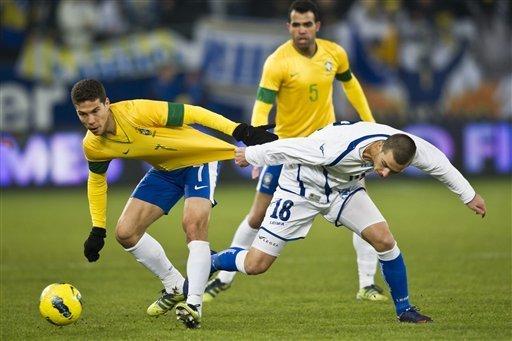
This wasn't the first time that the Lazio man had been played out of position for the
seleção. Hernanes' first appearance under Mano Menezes,
against France back in February 2011, saw him line up on the left side of a midfield four.
O Propheta (The Prophet) struggled to get involved in that game, grew frustrated, and was dismissed for a clumsy challenge on Karim Benzema.
The denouement of Menezes' selection against Bosnia was equally worrying, if less dramatic. After a lively start during which he took up a number of good positions, Hernanes' influence waned, culminating in his substitution in the second period. His role, whilst slightly different to that which he was asked to fulfill against France (against Bosnia, Brazil's formation hovered between a 4-2-2-2 and a lopsided 4-2-3-1, with Hernanes far less attacking than Neymar/Ronaldinho on the left), again failed to suit the 26-year-old.
To clarify: the problem is not that Hernanes cannot do a job as a wide midfielder. He attacks with purpose (if not with pace) and has the tactical nous to provide cover for whichever cavalier full-back happens to be stationed behind him. The issue, rather, it is that his sublime skills are wasted in that position. Hernanes is suffering for his versatility.
Patient and thoughtful, Hernanes is the type of player around which great sides ought to be built. A playmaker in the most literal sense, he brings out the best in those around him, rarely succumbing to needless flashiness or swagger. Hernanes is also brilliantly two-footed - an increasingly rare attribute in the modern game.
This skillset makes Hernanes ideally suited to central roles, in which he has shone at club level. His
début season for Lazio - during which he was largely used just behind the strikers - earnt him plaudits from observers, many of whom expressed their surprise that a player of his calibre had remained in Brazil until his mid-twenties. While his form has dipped slightly this term, he remains one of the most watchable midfielders in Serie A.
Unfortunately for Hernanes, he seems unlikely to be entrusted with Brazil's number ten shirt in the near future. Whilst the aging Ronaldinho should drop down the pecking order after his laughably bad display against Bosnia, competition remains stiff. Paulo Henrique Ganso appears to be the heir apparent
despite recent teething troubles, whilst the last man to truly make the role his own - Kaká - could yet come back into contention. Hernanes, for all his class, has yet to convince Menezes of his credentials in this position.
The past, however, provides reason to be hopeful. Fans of São Paulo - the club for whom Hernanes made his name - will fondly remember his performances in a deep midfield role, from which he initiated attacks and distributed the ball with admirable efficiency. Whilst hardly a traditional defensive midfielder, Hernanes made the Brasileirão's 2008 team of the year in precisely that position, thus challenging the received wisdom that all defenses must be screened by a pair of cold-hearted destroyers.
It is in this position that Hernanes could blossom for Brazil. Whilst the likes of Lucas Leiva and Sandro perform an important function, Menezes' tendency to pair them with leggy runners (Elias and Ramires, in particular) has deprived the
seleção of technical quality in the centre of the park. With Neymar and Ganso disinclined to drop deep, Brazil's attacks often break down before they even reach the front men, causing frustration among players and supporters alike.
The presence of Hernanes would alleviate this problem, whilst also allowing Menezes to return to the 4-2-1-3 formation of which he initially seemed so fond. By employing Hernanes as a
regista in the midfield two, Menezes could improve Brazil's ball retention and take some of the creative pressure off Paulo Henrique Ganso, without sacrificing manpower in front of the back four. The move would also encourage the employment of a natural right-sided player in attack - Hulk springs to mind.
Unfortunately for Hernanes, this ploy is likely to remain filed under "pipe dreams" whilst Menezes has the reigns. The former Corinthians boss continues to offer opportunities to players in the central midfield area (see Ralf and Fernandinho, in addition to those already mentioned), but seems sceptical of the need for passing quality from deep.
Ironically, the situation in which Hernanes finds himself is not unlike that of Elano in Dunga's Brazil side. A visionary central playmaker at his best (see his early performances for Manchester City), Elano was employed on the right of a lopsided 4-2-3-1 formation, charged with providing cover for whenever Maicon charged up the touchline. Whilst he performed admirably, one felt that Elano's skills would have been put to better use in central areas.
All this, of course, reflects rather badly on Mano Menezes. Heralded as the saviour of the
seleção upon taking the Brazil job (and after promising displays in early matches), he has since fallen into the same traps as his predecessor: failing to prioritise passing ability in central areas (Dunga's bruisers have merely been replaced by rangy all-rounders) and shunting potential matchwinners into poorly-defined wide roles. Given that Hernanes' potential is even greater than Elano's was under Dunga, one must hope that history stops repeating itself soon.
A version of this article was published by The Guardian HERE.
(Photo credit: AP Photo/Keystone/Ennio Leanza.)


