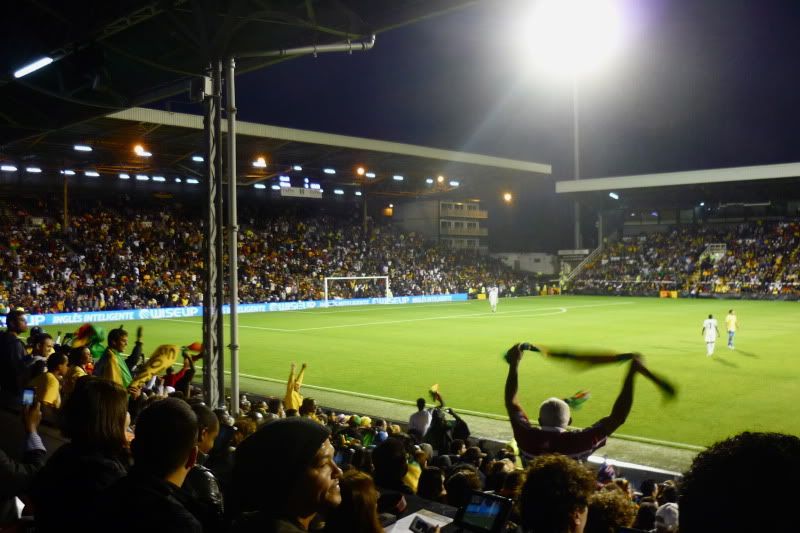
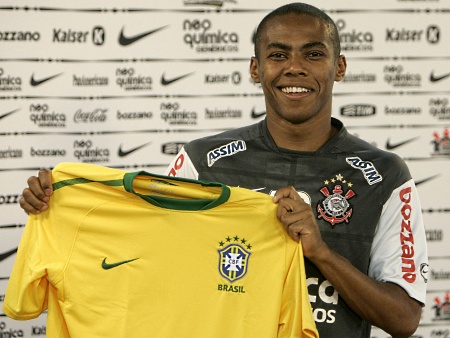
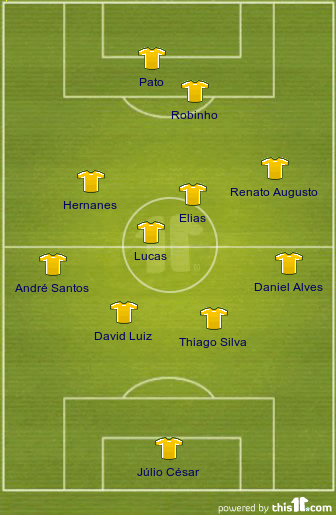
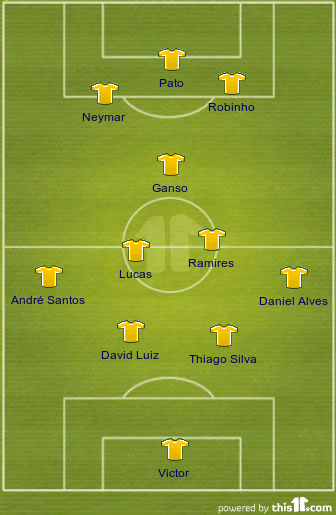
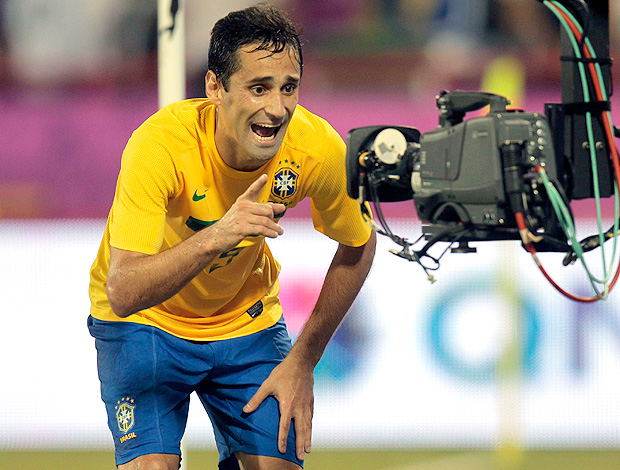
Brazil picked up their second win in four days this evening, overcoming a disappointing Egypt side in Doha. Although hardly a stellar performance from the seleção, a number of players staked their claim for a regular spot in Mano Menezes' lineup.
Brazil 2-0 Egypt
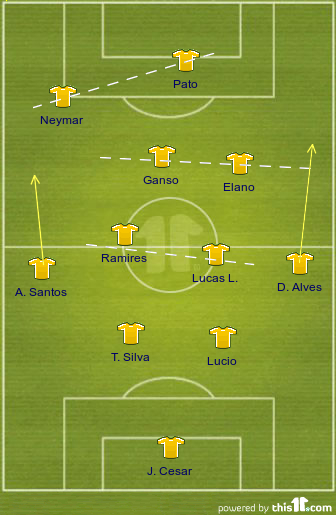
Having watched his side struggle in Libreville, Menezes shuffled his pack slightly, handing starts to Fernandinho and Lucas Leiva deep in midfield. Former Santos starlet Alex Sandro earnt a first senior start at leftback, whilst David Luiz and Daniel Alves were also drafted into the backline. Interestingly, the side's shape also changed: the 4-2-2-2 against Gabon was replaced by a lopsided 4-2-3-1 in Doha. Hulk started high on the right (a position that he is well accustomed to, of course), with Hernanes slightly deeper on the left. Bruno César occupied the role of central playmaker.
Brazil started well, with two players in particular impressing. David Luiz showed just why he he can be such an asset for Menezes' side: his crisp passing and incisive bursts provided impetus from the back, whilst also taking pressure off Lucas Leiva. Alex Sandro, meanwhile, provided a real threat from fullback, linking well with Hernanes and drawing a sprawling save from Ahmed Al Shenawy midway through the half.
Jonas, a striker of whose qualities I haven't always been convinced, also played well, linking up with the midfield and dropping deep when necessary. The Valencia forward was rewarded for his efforts towards the end of the opening period, tapping home after good build-up play from Hulk and Bruno César (who had a quiet evening on the whole). Egypt briefly threatened to rally, but Diego Alves' save from Shikabala's free-kick remained his only meaningful work of the half.
The early stages of the second period saw Brazil continue to dominate proceedings. A magnificent through-ball from Fernandinho (reminiscent of his assist against Ghana in September) presented Jonas with the chance to double the seleção's lead, but some brave defending from Ahmed Hegazi bailed Egypt out at the last. Jonas, however, would not be denied. When Fernandinho's header was parried by Al Shenawy just minutes later, Brazil's No.9 tapped home his second international goal, effectively ending the game as a contest.
The game became rather boring from that point. Egypt grew into the match, but failed to test Diego Alves, whilst Hernanes dragged Brazil's best chance wide at the other end. Only a late cameo appearance from former Cruzeiro youngster Dudu livened up the closing stages: his electric running provided Brazil with a cutting edge that they had been missing for long stretches of the match.
This, then, was another fairly routine win for the seleção. The performance, though, will likely have pleased Menezes: although Egypt failed to provide the challenge that he might have hoped for, Brazil looked far more competent than they did against Gabon four days earlier. With the likes of Neymar, Leandro Damião, Paulo Henrique Ganso and Kaká all likely to come back into contention in the coming months, and his side ending the year on a five-game unbeaten streak, Mano will head into 2012 with cautious optimism.
(Photo credit: Reuters.)
THIS IS NOW JUST A FEED OF LINKS TO MY BRAZILIAN FOOTBALL FEATURES – FOR OTHER WORK, SEE MY TWITTER FEED
Showing posts with label Tactics. Show all posts
Monday, 14 November 2011
Tuesday, 6 September 2011
Leandro Damião On Target as Brazil Beat Ghana
If London really is the seleção's home from home, they could hardly have chosen better visitors than Ghana. One small corner of the capital was awash with colour and song last night, as two of the world's liveliest sets of fans converged on Craven Cottage. The match - the latest in what will soon seem like a never-ending series of pre-World Cup friendlies for Brazil - was largely entertaining, but told us rather little about the progress of Mano Menezes' side.
Brazil 1-0 Ghana
The big news in the lead-up to yesterday's game had been the recall of Ronaldinho Gaúcho, who has been in imperious form for Flamengo of late. The veteran began the match on the left of a front three, with Neymar on the right and Leandro Damião the target man. In midfield, Fernandinho earnt another start alongside Lucas Leiva, whilst Paulo Henrique Ganso was restored to the side as playmaker. The latter's evening, however, was quickly curtailed; he limped off within the first ten minutes. That prompted an alteration in Brazil's midfield shape; the two-one triangle was reversed, with both Fernandinho and substitute Elias operating in shuttling roles just ahead of Lucas.
Do the bigode! Leandro Damião celebrates his first goal for Brazil.
The defining moment in the match occurred in the 34th minute. Ghana leftback Daniel Opare - whose walking of a disciplinary tightrope up to that point was truly circus-worthy - burst into the Brazil box, only to be dispossessed by Lúcio when shaping to shoot. The Internazionale defender launched straight into his extinction of the last dinosaur routine, prompting Mike Dean to issue a second yellow to Opare. If that decision - which was greeted with universal incredulity around the ground - didn't quite spell the end of the game as a contest, the opening goal certainly did. Fernandinho's magnificent pass released Leandro Damião, who slammed home his first international goal on the stroke of half time.
The second half was notable only for its one-sidedness. The introduction of Hulk initially created rotating trio of players (Hulk, Neymar, Ronaldinho) behind Damião, but this gradually turned into a flat line as Ghana's lack of attacking threat became manifest. With Daniel Alves and Marcelo overloading on the flanks, Brazil at times had as many as six men in the attacking third, with precious little space in which to operate. As Mano Menezes noted in his post-match press conference, this was simply attack vs. defence, and as such provided negligible insight into the workings of either side.
One man, however, seemed to be enjoying himself. Ronaldinho came alive in the second period, peppering the Ghana goal with a series of free-kicks and indulging in some crowd-pleasing tricks towards the end. The skeptics, of course, will take this as a telling microcosm of the player's post-Barça years; that Ronaldinho might generate a wealth of Olés when a side is dominating possession in a friendly, but simply can't cut it anymore when the chips are down. One would be mistaken, however, to write the 31-year-old off so hastily. His first half performance, although admittedly indifferent, was that of a man who will need time to re-acclimatise to the pace of international football, rather than one whose career has reached the point of no return. I, for one, hope to witness a few more moments of buck-toothed genius in the next couple of years.
(Photo credits; (1) Writer's own, (2) & (3) Mowa Press.)
Brazil 1-0 Ghana
The big news in the lead-up to yesterday's game had been the recall of Ronaldinho Gaúcho, who has been in imperious form for Flamengo of late. The veteran began the match on the left of a front three, with Neymar on the right and Leandro Damião the target man. In midfield, Fernandinho earnt another start alongside Lucas Leiva, whilst Paulo Henrique Ganso was restored to the side as playmaker. The latter's evening, however, was quickly curtailed; he limped off within the first ten minutes. That prompted an alteration in Brazil's midfield shape; the two-one triangle was reversed, with both Fernandinho and substitute Elias operating in shuttling roles just ahead of Lucas.
By that point, Ghana has already built up a head of steam. The Black Stars had plenty of joy down the channels early on, forcing Daniel Alves and Marcelo to play rather more cautiously than they would have liked. Dnipro colossus Derek Boateng single-handedly dominated the midfield zone during the opening half an hour, snuffing out nascent Brazil attacks and using the ball with admirable economy. The seleção only managed one meaningful attack in that period, but Leandro Damião's cool lob was disallowed for offside.
Do the bigode! Leandro Damião celebrates his first goal for Brazil.The defining moment in the match occurred in the 34th minute. Ghana leftback Daniel Opare - whose walking of a disciplinary tightrope up to that point was truly circus-worthy - burst into the Brazil box, only to be dispossessed by Lúcio when shaping to shoot. The Internazionale defender launched straight into his extinction of the last dinosaur routine, prompting Mike Dean to issue a second yellow to Opare. If that decision - which was greeted with universal incredulity around the ground - didn't quite spell the end of the game as a contest, the opening goal certainly did. Fernandinho's magnificent pass released Leandro Damião, who slammed home his first international goal on the stroke of half time.
The second half was notable only for its one-sidedness. The introduction of Hulk initially created rotating trio of players (Hulk, Neymar, Ronaldinho) behind Damião, but this gradually turned into a flat line as Ghana's lack of attacking threat became manifest. With Daniel Alves and Marcelo overloading on the flanks, Brazil at times had as many as six men in the attacking third, with precious little space in which to operate. As Mano Menezes noted in his post-match press conference, this was simply attack vs. defence, and as such provided negligible insight into the workings of either side.
One man, however, seemed to be enjoying himself. Ronaldinho came alive in the second period, peppering the Ghana goal with a series of free-kicks and indulging in some crowd-pleasing tricks towards the end. The skeptics, of course, will take this as a telling microcosm of the player's post-Barça years; that Ronaldinho might generate a wealth of Olés when a side is dominating possession in a friendly, but simply can't cut it anymore when the chips are down. One would be mistaken, however, to write the 31-year-old off so hastily. His first half performance, although admittedly indifferent, was that of a man who will need time to re-acclimatise to the pace of international football, rather than one whose career has reached the point of no return. I, for one, hope to witness a few more moments of buck-toothed genius in the next couple of years.
(Photo credits; (1) Writer's own, (2) & (3) Mowa Press.)
Wednesday, 10 August 2011
Play It Again, Mano; Brazil Lose to Germany in Stuttgart
The failings of the current Brazil side have been (hopefully) well documented by yours truly over the past year. Too many jack-of-all-trade midfielders, a cluster of overly similar players in attack, the lack of a ball-player in front of the back four... and so on. You will forgive me then, for not producing an enormously detailed analysis of Brazil's loss to Germany on Wednesday night; this was, for the most part, a defeat borne of the very same mistakes that have characterised previous matches.
Germany 3-2 Brazil
With Lucas Leiva serving a one-match ban for the seleção, Mano Menezes handed a first start to Corinthians juggernaut Ralf, who has been in impressive form at club level. He lined up in midfield alongside Ramires and Fernandinho, who was surprisingly included at the expense of Paulo Henrique Ganso. That decision was ostensibly based on the fact that Ganso has yet to regain full fitness after injury, but also suggests that the playmaker's listless recent form hasn't gone unnoticed. The selection, however, meant that Brazil were not only deprived of a regista in the midfield platform, but also of a No.10. It was perhaps not insignificant that Neymar, rather than Fernandinho, was given the jersey usually assigned to Ganso; an oblique message of "hey fans, this lineup still has creative potential!" could be deciphered.
In his defence, Fernandinho enjoyed a decent début; his dynamism improved Brazil's saída de bola (the transfer of the ball between defensive and attacking sectors), the importance of which Menezes has repeatedly stressed. That his arrival in the side coincided with another limp performance from the seleção meant that he was unfairly criticised in some quarters following the match. Brazil's shortcomings, though, were to be found elsewhere.
In defence, the partnership formed by Lúcio and Thiago Silva - which appeared to be developing rather nicely earlier this year - now has major question marks over it. True, Germany's opener owed more to generous (read: laughable) refereeing than to any major error on Lúcio's part, but the extent to which Brazil's backline had been dragged apart in the build-up to the penalty was notable. Germany's second goal, tucked away by the effervescent Mario Götze, told a similar story; an inviting chasm opened up between the seleção centrebacks, and was duly exploited. The hosts' third goal, of course, must be put down to individual error; André Santos (of whom I have been so unbending in my support) provided his myriad detractors with plenty of ammunition.
Even going forward, Brazil were sloppy. With the midfield looking even more bereft of ideas than usual, Robinho and Neymar were called upon to provide some invention behind Alexandre Pato. They were largely unable to do so. Ganso's introduction in the second period emphasised the need for someone of his ilk on the park; he didn't misplace a single pass (thanks for that one, Opta), and initiated the move from which Neymar struck Brazil's second. In truth, the 3-2 scoreline was kind on the seleção; Robinho's opener came from a penalty award even more dubious than the one which preceded Schweinsteiger's goal.
The result means that, after 13 games in charge, Menezes has guided his charges to a mere 6 victories, none of which have come against purported top-rate opposition. Matches against Egypt, Argentina, and Costa Rica will provide further challenges over the next two months, but for many, the writing is already on the wall; Menezes simply cannot cut it at this level. One thing seems clear; the former Corinthians boss must find a way to avoid repeating the handful of tactical mistakes that have peppered his stewardship. A manager must be judged - at least in part - on his ability to react to changing circumstances on the pitch. By this metric, Menezes has an enormous amount of work to do.
(Photo credit; Kai Pfaffenbach.)
Germany 3-2 Brazil
With Lucas Leiva serving a one-match ban for the seleção, Mano Menezes handed a first start to Corinthians juggernaut Ralf, who has been in impressive form at club level. He lined up in midfield alongside Ramires and Fernandinho, who was surprisingly included at the expense of Paulo Henrique Ganso. That decision was ostensibly based on the fact that Ganso has yet to regain full fitness after injury, but also suggests that the playmaker's listless recent form hasn't gone unnoticed. The selection, however, meant that Brazil were not only deprived of a regista in the midfield platform, but also of a No.10. It was perhaps not insignificant that Neymar, rather than Fernandinho, was given the jersey usually assigned to Ganso; an oblique message of "hey fans, this lineup still has creative potential!" could be deciphered.
In his defence, Fernandinho enjoyed a decent début; his dynamism improved Brazil's saída de bola (the transfer of the ball between defensive and attacking sectors), the importance of which Menezes has repeatedly stressed. That his arrival in the side coincided with another limp performance from the seleção meant that he was unfairly criticised in some quarters following the match. Brazil's shortcomings, though, were to be found elsewhere.
In defence, the partnership formed by Lúcio and Thiago Silva - which appeared to be developing rather nicely earlier this year - now has major question marks over it. True, Germany's opener owed more to generous (read: laughable) refereeing than to any major error on Lúcio's part, but the extent to which Brazil's backline had been dragged apart in the build-up to the penalty was notable. Germany's second goal, tucked away by the effervescent Mario Götze, told a similar story; an inviting chasm opened up between the seleção centrebacks, and was duly exploited. The hosts' third goal, of course, must be put down to individual error; André Santos (of whom I have been so unbending in my support) provided his myriad detractors with plenty of ammunition.
Even going forward, Brazil were sloppy. With the midfield looking even more bereft of ideas than usual, Robinho and Neymar were called upon to provide some invention behind Alexandre Pato. They were largely unable to do so. Ganso's introduction in the second period emphasised the need for someone of his ilk on the park; he didn't misplace a single pass (thanks for that one, Opta), and initiated the move from which Neymar struck Brazil's second. In truth, the 3-2 scoreline was kind on the seleção; Robinho's opener came from a penalty award even more dubious than the one which preceded Schweinsteiger's goal.
The result means that, after 13 games in charge, Menezes has guided his charges to a mere 6 victories, none of which have come against purported top-rate opposition. Matches against Egypt, Argentina, and Costa Rica will provide further challenges over the next two months, but for many, the writing is already on the wall; Menezes simply cannot cut it at this level. One thing seems clear; the former Corinthians boss must find a way to avoid repeating the handful of tactical mistakes that have peppered his stewardship. A manager must be judged - at least in part - on his ability to react to changing circumstances on the pitch. By this metric, Menezes has an enormous amount of work to do.
(Photo credit; Kai Pfaffenbach.)
Monday, 4 July 2011
Seleção Draw Blank Against Venezuela in Copa América
As opening gambits go, it was far from convincing. Having watched their most bitter of rivals stutter against Bolivia (a result which was reported with considerable verve in Brazil) the seleção met Venezuela, hoping to put down an early marker in the competition. A year after being knocked out of the World Cup with barely a whimper of protest, opportunity hung heavy in the La Plata air; this was the moment for Brazil to shake off the dust, to reintroduce itself to the world. A team rich in youthful vim and logic-defying hair styles marched onto the pitch. Mano Menezes looked on sagely as Neymar, Ganso et al. took their starting positions. The stage was set. And then... nothing.
Brazil 0-0 Venezuela
The seleção, in fairness, started the match with considerable intent; Neymar was typically busy, combining with André Santos on the left, and cutting inside to good effect. As usual, Daniel Alves channelled his inner mad dog, sprinting wildly up and down the right flank. One such burst brought Brazil their best chance of the match; Alexandre Pato's effort clattered back off the bar with Renny Vega well beaten. Defensively, Menezes' side started impeccably, pressing high up the pitch, and regaining possession before their opponents had time to mount any threat. Consequently, Venezuela only managed one notable foray in the opening period, an attack which resulted in the (otherwise faultless) Thiago Silva being booked.
This level of comfort should have increased Brazil's attacking capabilities, prompting one of the deeper midfielders to contribute more in attack. Given Lucas Leiva's recent success in shielding the back four, that duty fell on the shoulders of Ramires. Unfortunately, the Chelsea man (a good player though he is) simply doesn't have the skill set to be effective in this task; energetic surges culminated with the ball bobbling away from him, and passes, when played forward, seemed to be observing some overly draconian speed limit. Paulo Henrique Ganso, who looked slightly sluggish in only his second match back since injury, was deprived of any purposeful link-up in the centre of the park, and as a result spent rather too much time trying to play ambitious through-passes to the forwards.
And what of Brazil's strikers? Neymar faded somewhat after his bright start, yet still attracted two or three markers every time he received possession, thus (theoretically) creating room for his colleagues. Alexandre Pato turned in a middling performance; two moments of sublime skill (his effort against the bar, and a jaw-dropping piece of control from a Dani Alves long ball) didn't disguise the fact that he was marked out of the game for long periods. That just leaves... (checks team sheet)... oh, Robinho. Well Robinho was... He had a shot in the first half, didn't he...? Or was that someone else...?
Worryingly for Menezes, the match followed the script that has defined a number of recent Brazil matches. Despite exerting early pressure, the seleção couldn't manage a break-through, and proceeded to turn in a disorganised, panicky, second-half display. His substitutions (Fred, Lucas, and Elano all entered the fray) made scant difference, and Venezuela grew in confidence as the match wore on. Both Júlio César and Lúcio needed all of their experience to snuff out a couple of promising counter attacks from the underdogs. The final whistle almost came as a relief to Brazil; one sensed that they wouldn't have scored in another hour of play.
So far, so gloomy. A little perspective, however, is called for. This wouldn't be the first time that a team fluffed their opening lines before embarking on an impressive tournament run; Spain demonstrated as much in South Africa last year. The performance (and the attendant criticism) could also serve to galvanise the seleção, motivating players for the battles ahead. Menezes will be aware, though, of the severity of his situation; further turgid performances against Paraguay and Ecuador would almost certainly lead to calls for his head.
It would not be surprising if, due to that mounting pressure (and his side's lack of fluency), Menezes sacrificed Robinho against Paraguay. Elano, who has proved himself to be a dependable figure in recent years, would be the main candidate for inclusion, and would occupy a withdrawn role on the right. That, ironically, would transform Menezes' formation into almost the exact system employed by Dunga in South Africa; the lopsided 4-2-2-2. We have already seen that one of the shortcomings of Dunga's reign - the refusal to employ a regista in the midfield platform - has merely been reproduced by Menezes. The main difference, then, is largely one of attacking personnel. Menezes must hope that his faith in Brazil's emerging stars is justified.
(For more on the tactical state of the seleção, check out this post from the ever-excellent Santa Pelota, and this one over at the brilliant Zonal Marking.)
(Photo credits; (1) Paulo Whitaker, (2) Lea la Valle.)
Brazil 0-0 Venezuela
The seleção, in fairness, started the match with considerable intent; Neymar was typically busy, combining with André Santos on the left, and cutting inside to good effect. As usual, Daniel Alves channelled his inner mad dog, sprinting wildly up and down the right flank. One such burst brought Brazil their best chance of the match; Alexandre Pato's effort clattered back off the bar with Renny Vega well beaten. Defensively, Menezes' side started impeccably, pressing high up the pitch, and regaining possession before their opponents had time to mount any threat. Consequently, Venezuela only managed one notable foray in the opening period, an attack which resulted in the (otherwise faultless) Thiago Silva being booked.
This level of comfort should have increased Brazil's attacking capabilities, prompting one of the deeper midfielders to contribute more in attack. Given Lucas Leiva's recent success in shielding the back four, that duty fell on the shoulders of Ramires. Unfortunately, the Chelsea man (a good player though he is) simply doesn't have the skill set to be effective in this task; energetic surges culminated with the ball bobbling away from him, and passes, when played forward, seemed to be observing some overly draconian speed limit. Paulo Henrique Ganso, who looked slightly sluggish in only his second match back since injury, was deprived of any purposeful link-up in the centre of the park, and as a result spent rather too much time trying to play ambitious through-passes to the forwards.
And what of Brazil's strikers? Neymar faded somewhat after his bright start, yet still attracted two or three markers every time he received possession, thus (theoretically) creating room for his colleagues. Alexandre Pato turned in a middling performance; two moments of sublime skill (his effort against the bar, and a jaw-dropping piece of control from a Dani Alves long ball) didn't disguise the fact that he was marked out of the game for long periods. That just leaves... (checks team sheet)... oh, Robinho. Well Robinho was... He had a shot in the first half, didn't he...? Or was that someone else...?
Worryingly for Menezes, the match followed the script that has defined a number of recent Brazil matches. Despite exerting early pressure, the seleção couldn't manage a break-through, and proceeded to turn in a disorganised, panicky, second-half display. His substitutions (Fred, Lucas, and Elano all entered the fray) made scant difference, and Venezuela grew in confidence as the match wore on. Both Júlio César and Lúcio needed all of their experience to snuff out a couple of promising counter attacks from the underdogs. The final whistle almost came as a relief to Brazil; one sensed that they wouldn't have scored in another hour of play.
So far, so gloomy. A little perspective, however, is called for. This wouldn't be the first time that a team fluffed their opening lines before embarking on an impressive tournament run; Spain demonstrated as much in South Africa last year. The performance (and the attendant criticism) could also serve to galvanise the seleção, motivating players for the battles ahead. Menezes will be aware, though, of the severity of his situation; further turgid performances against Paraguay and Ecuador would almost certainly lead to calls for his head.
It would not be surprising if, due to that mounting pressure (and his side's lack of fluency), Menezes sacrificed Robinho against Paraguay. Elano, who has proved himself to be a dependable figure in recent years, would be the main candidate for inclusion, and would occupy a withdrawn role on the right. That, ironically, would transform Menezes' formation into almost the exact system employed by Dunga in South Africa; the lopsided 4-2-2-2. We have already seen that one of the shortcomings of Dunga's reign - the refusal to employ a regista in the midfield platform - has merely been reproduced by Menezes. The main difference, then, is largely one of attacking personnel. Menezes must hope that his faith in Brazil's emerging stars is justified.
(For more on the tactical state of the seleção, check out this post from the ever-excellent Santa Pelota, and this one over at the brilliant Zonal Marking.)
(Photo credits; (1) Paulo Whitaker, (2) Lea la Valle.)
Sunday, 5 June 2011
Brazil Play Out Goalless Draw With Holland
Let's cut to the chase; this was far from a classic. Brazil's first game in home soil in around three years turned out to be a damp squib, as they toiled to a 0-0 draw with World Cup nemeses Holland. A packed house at the Serra Dourada was audibly frustrated by the spectacle, booing the seleção off the pitch at the final whistle.
The return of Robinho to Brazil's starting lineup meant that Mano Menezes could return to his preferred three-man front line; the Milan man started on the right, with Fred central and Neymar drifting from the left. The shape in midfield was similar to that employed against Scotland in March; Lucas acted as a deep anchor, with Elano and Ramires slightly advanced to his right and left respectively. This 1-2 midfield triangle has been forced upon Menezes somewhat with Paulo Henrique Ganso's continuing injury problems; the lack of a truly creative force has meant that Ramires is used more offensively than he was in Menezes' first couple of games in charge. It is a role that he can't quite fulfil; despite producing the odd surging run, Ramires' lack of passing ability can impede Brazil's fluency.
Elano, in truth, fared no better; struggling to exert any influence against a competitive Dutch midfield. The shortcomings in the centre of the park meant that - as predicted - creative responsibility fell on the shoulders of Neymar and Robinho. The latter dropped slightly deeper, to no real effect; in fact, it was striking how little he and Daniel Alves combined down the right. Neymar was far more active on his flank, linking well with André Santos (a pleasing feature of Brazil's recent matches) and providing the penetration that his side so desperately needed. Fred, deprived of crosses, cut a lonely figure for much of the game.
In a dire opening period, it was Holland who created the better chances. Ibrahim Afellay brought two fine saves from Júlio César, and Robin Van Persie glanced wide with the goal beckoning. Brazil's best attacks were, unsurprisingly, instigated by Neymar; an excellent pass from the youngster allowed Robinho to tee up Ramires, only for the ensuing goal to be wrongly ruled out for offside. Opportunities were more plentiful for the hosts after the break; Tim Krul denied Neymar, Fred miscued from a decent position, and Thiago Silva's effort was deflected past the post. Mano Menezes threw on youngsters Leandro Damião and Lucas, hoping for a moment of inspiration. It didn't come. Instead, Brazil were reduced to ten men when Ramires picked up his second yellow card.
The performance, then, was one that will concern many fans of the seleção. The lack of imagination and technical ability in midfield meant that Brazil struggled to dictate the rhythm of the game; indeed, there was a period during the first half when they struggled to string together three consecutive passes. There were a couple of positives; Júlio César looked to be back to something resembling his best, whilst the central defensive pairing of Thiago Silva and Lúcio (who, incidentally, was making his 100th appearance in the yellow jersey) looked relatively solid. The feverish optimism which surrounded Menezes' first matches in charge, however, is now a distant memory. With the Copa América fast approaching, he seems to be increasingly reliant on the mercurial talents of Neymar to keep the public onside. It's an enormous weight to put on such young shoulders.
(Photo credits; (1) Jefferson Bernardes, (2) Ricardo Nogueira.)
The return of Robinho to Brazil's starting lineup meant that Mano Menezes could return to his preferred three-man front line; the Milan man started on the right, with Fred central and Neymar drifting from the left. The shape in midfield was similar to that employed against Scotland in March; Lucas acted as a deep anchor, with Elano and Ramires slightly advanced to his right and left respectively. This 1-2 midfield triangle has been forced upon Menezes somewhat with Paulo Henrique Ganso's continuing injury problems; the lack of a truly creative force has meant that Ramires is used more offensively than he was in Menezes' first couple of games in charge. It is a role that he can't quite fulfil; despite producing the odd surging run, Ramires' lack of passing ability can impede Brazil's fluency.
Elano, in truth, fared no better; struggling to exert any influence against a competitive Dutch midfield. The shortcomings in the centre of the park meant that - as predicted - creative responsibility fell on the shoulders of Neymar and Robinho. The latter dropped slightly deeper, to no real effect; in fact, it was striking how little he and Daniel Alves combined down the right. Neymar was far more active on his flank, linking well with André Santos (a pleasing feature of Brazil's recent matches) and providing the penetration that his side so desperately needed. Fred, deprived of crosses, cut a lonely figure for much of the game.
In a dire opening period, it was Holland who created the better chances. Ibrahim Afellay brought two fine saves from Júlio César, and Robin Van Persie glanced wide with the goal beckoning. Brazil's best attacks were, unsurprisingly, instigated by Neymar; an excellent pass from the youngster allowed Robinho to tee up Ramires, only for the ensuing goal to be wrongly ruled out for offside. Opportunities were more plentiful for the hosts after the break; Tim Krul denied Neymar, Fred miscued from a decent position, and Thiago Silva's effort was deflected past the post. Mano Menezes threw on youngsters Leandro Damião and Lucas, hoping for a moment of inspiration. It didn't come. Instead, Brazil were reduced to ten men when Ramires picked up his second yellow card.
The performance, then, was one that will concern many fans of the seleção. The lack of imagination and technical ability in midfield meant that Brazil struggled to dictate the rhythm of the game; indeed, there was a period during the first half when they struggled to string together three consecutive passes. There were a couple of positives; Júlio César looked to be back to something resembling his best, whilst the central defensive pairing of Thiago Silva and Lúcio (who, incidentally, was making his 100th appearance in the yellow jersey) looked relatively solid. The feverish optimism which surrounded Menezes' first matches in charge, however, is now a distant memory. With the Copa América fast approaching, he seems to be increasingly reliant on the mercurial talents of Neymar to keep the public onside. It's an enormous weight to put on such young shoulders.
(Photo credits; (1) Jefferson Bernardes, (2) Ricardo Nogueira.)
Monday, 28 March 2011
SKP at the Emirates; Neymar Inspires Brazil to Victory Over Scotland
Man of the moment Neymar shot the seleção to a comfortable 2-0 win over Scotland yesterday, with SKP in attendance at the Emirates stadium. With the match gaining substantial press coverage in the UK, allow me to refrain from providing a regular match report. Instead, I shall review Brazil's performance with player ratings, in partial homage to one of my post-game pub-goers (of which more later). I might rate some other things too...
Júlio César - 7/10
A watching brief for the Internazionale man.
Daniel Alves - 8/10
Outstanding energy. Always an outlet on the right side.
Lúcio - 7/10
A reassuring presence in defence, and burst forward to good effect a couple of times.
Thiago Silva - 7/10
Looked more composed alongside Lúcio than he has with David Luiz. Dealt well with the hard-running Kenny Miller.
André Santos - 8/10
Continues to impress; linked up well with Neymar, powered down the flank, and set up the opening goal. Marcelo might have to wait a while longer to earn a start.
Lucas Leiva - 6/10
Marshalled the defence reasonably well, but passing was fairly wayward.
Ramires - 6/10
Strong in the tackle and full of running, yet a lack of end-product. A case in point; his glorious surging run in the second half, which culminated in a terrible attempted pass to Neymar.
Elano - 7/10
Neat in possession, but not much creativity. Good dead-ball delivery.
Jádson - 4/10
A poor display from the Shakhtar Donetsk man; struggled to make any headway from starting spot on the right, and fared little better in the centre.
Leandro Damião - 7/10
A decent début from the youngster, who led the line with some aplomb. Hit the bar with a towering header, but should have done better with two second-half chances.
Neymar - 9/10
Brazil's standout performer; his tricks and pace provided a constant threat on the left of attack. Scored both goals, but should also be saluted for his contibution to the seleção's pressing game, particularly in the first half.
Substitutes - 6/10
A mixed bag. Young São Paulo flyer Lucas went on a couple of mesmerising runs, and would have picked up an assist if it wasn't for Jonas' lack of composure in the dying minutes. Elias and Renato Augusto didn't do much.
Mano Menezes - 7/10
The Brazil boss implemented a slight formation change in midfield; rather than having a two-player platform in front of the defence and one player in front (e.g. against the USA, Ganso played ahead of Lucas and Ramires), Menezes played two players - Elano and Ramires - in advance of Lucas. This, for the most part, helped Brazil commit numbers to the attack; Ramires was able to contribute down the left, with Elano doing a similar job on the right. The lack of a creative passer, however, remains a problem, and it seems doubtful whether the flipping of the midfield triangle will suit Paulo Henrique Ganso when he returns to the side.
In terms of personnel, there were positives and negatives. Leandro Damião proved an effective fixed point in attack, holding his position to create space for midfield runners and for Neymar. Alexandre Pato, although a more gifted player, cannot really be employed to that end. Lúcio and Elano enjoyed solid games on their return to the side, providing further evidence that Mano's reconciliation of old and new is bearing fruit. The selection of Jádson on the right, however, was problematic. A playmaker by trade, the 27-year-old offered little penetration, often simply passing back down the line to the more dynamic Daniel Alves. A temporary switch of positions with Elano merely replicated the problem. Menezes must wish to avoid the use of two out-and-out attackers on the flanks; otherwise, the selection of Porto winger Hulk on the right would be a no-brainer.
Pre-match entertainment - 9/10
Samba band thumping away on the concourse? Check. Video of all Ronaldo's World Cup goals? Check. Ronaldo actually coming onto the pitch to salute the crowd?! CHECK! The roar that greeted O Fenômeno was one of the best moments of the afternoon, and surely brought a lump to the throat of even the most hardened sceptics.
Stadium music selection - 3/10
The stadium PA blasted out a selection of music to inspire the Scotland fans; "We'll Be Coming Down the Road" and the Proclaimers' "500 miles" were greeted warmly by those from North of the border. Attempts to get the Brazil fans geared up were decidely less succesful. Note to staff at the Emirates; Ricky Martin is not, I repeat IS NOT, Brazilian.
Scotland fans - 8/10
Loud, proud, and be-kilted, the (supposed) away fans created a great atmosphere in the Emirates. When a small pocket of Brazil fans piped up with a chorus of "Eu sou Brasileiro..." where SKP was seated, the Scotland fans respectfully clapped along, before launching into a rousing (but utterly bemusing) rendition of "Do-Re-Mi" from The Sound of Music. Weird and wonderful.
The idiot who threw a banana at Neymar - 0/10
An idiot.
Post-match amusement - 10/10
After the game I enjoyed a few drinks with blogging royalty; Michael Cox (of Zonal Marking fame), Rupert Fryer (South American Football don), and Scott Johnston (who runs TheFootyBlog.net). Lovely guys one and all.
(Photo credits; (1) & (3) Writer's own, (2) Tom Jenkins.)
Júlio César - 7/10
A watching brief for the Internazionale man.
Daniel Alves - 8/10
Outstanding energy. Always an outlet on the right side.
Lúcio - 7/10
A reassuring presence in defence, and burst forward to good effect a couple of times.
Thiago Silva - 7/10
Looked more composed alongside Lúcio than he has with David Luiz. Dealt well with the hard-running Kenny Miller.
André Santos - 8/10
Continues to impress; linked up well with Neymar, powered down the flank, and set up the opening goal. Marcelo might have to wait a while longer to earn a start.
Lucas Leiva - 6/10
Marshalled the defence reasonably well, but passing was fairly wayward.
Ramires - 6/10
Strong in the tackle and full of running, yet a lack of end-product. A case in point; his glorious surging run in the second half, which culminated in a terrible attempted pass to Neymar.
Elano - 7/10
Neat in possession, but not much creativity. Good dead-ball delivery.
Jádson - 4/10
A poor display from the Shakhtar Donetsk man; struggled to make any headway from starting spot on the right, and fared little better in the centre.
Leandro Damião - 7/10
A decent début from the youngster, who led the line with some aplomb. Hit the bar with a towering header, but should have done better with two second-half chances.
Neymar - 9/10
Brazil's standout performer; his tricks and pace provided a constant threat on the left of attack. Scored both goals, but should also be saluted for his contibution to the seleção's pressing game, particularly in the first half.
Substitutes - 6/10
A mixed bag. Young São Paulo flyer Lucas went on a couple of mesmerising runs, and would have picked up an assist if it wasn't for Jonas' lack of composure in the dying minutes. Elias and Renato Augusto didn't do much.
Mano Menezes - 7/10
The Brazil boss implemented a slight formation change in midfield; rather than having a two-player platform in front of the defence and one player in front (e.g. against the USA, Ganso played ahead of Lucas and Ramires), Menezes played two players - Elano and Ramires - in advance of Lucas. This, for the most part, helped Brazil commit numbers to the attack; Ramires was able to contribute down the left, with Elano doing a similar job on the right. The lack of a creative passer, however, remains a problem, and it seems doubtful whether the flipping of the midfield triangle will suit Paulo Henrique Ganso when he returns to the side.
In terms of personnel, there were positives and negatives. Leandro Damião proved an effective fixed point in attack, holding his position to create space for midfield runners and for Neymar. Alexandre Pato, although a more gifted player, cannot really be employed to that end. Lúcio and Elano enjoyed solid games on their return to the side, providing further evidence that Mano's reconciliation of old and new is bearing fruit. The selection of Jádson on the right, however, was problematic. A playmaker by trade, the 27-year-old offered little penetration, often simply passing back down the line to the more dynamic Daniel Alves. A temporary switch of positions with Elano merely replicated the problem. Menezes must wish to avoid the use of two out-and-out attackers on the flanks; otherwise, the selection of Porto winger Hulk on the right would be a no-brainer.
Pre-match entertainment - 9/10
Samba band thumping away on the concourse? Check. Video of all Ronaldo's World Cup goals? Check. Ronaldo actually coming onto the pitch to salute the crowd?! CHECK! The roar that greeted O Fenômeno was one of the best moments of the afternoon, and surely brought a lump to the throat of even the most hardened sceptics.
Stadium music selection - 3/10
The stadium PA blasted out a selection of music to inspire the Scotland fans; "We'll Be Coming Down the Road" and the Proclaimers' "500 miles" were greeted warmly by those from North of the border. Attempts to get the Brazil fans geared up were decidely less succesful. Note to staff at the Emirates; Ricky Martin is not, I repeat IS NOT, Brazilian.
Scotland fans - 8/10
Loud, proud, and be-kilted, the (supposed) away fans created a great atmosphere in the Emirates. When a small pocket of Brazil fans piped up with a chorus of "Eu sou Brasileiro..." where SKP was seated, the Scotland fans respectfully clapped along, before launching into a rousing (but utterly bemusing) rendition of "Do-Re-Mi" from The Sound of Music. Weird and wonderful.
The idiot who threw a banana at Neymar - 0/10
An idiot.
Post-match amusement - 10/10
After the game I enjoyed a few drinks with blogging royalty; Michael Cox (of Zonal Marking fame), Rupert Fryer (South American Football don), and Scott Johnston (who runs TheFootyBlog.net). Lovely guys one and all.
(Photo credits; (1) & (3) Writer's own, (2) Tom Jenkins.)
Friday, 11 February 2011
Prophet and Loss for Menezes as Seleção Suffer Les Bleus
To the cynics, Mano Menezes' seleção reign has been little more than a sparkly new paint-job on what is looking like an increasingly defunct car. Sure, Neymar, Alexandre Pato, and Paulo Henrique Ganso may have provided some youthful zest to Brazil's post-World Cup performances, but the side's shortcomings against the Ukraine (a terminally dull 2-0 win) and Argentina (a 1-0 loss) fuelled the flames of those who see Menezes as little more than a media savvy Dunga. Wednesday evening's defeat at the hands of France will likely have converted even more observers to this point of view. Are the doubters right?
Kind of. The mistakes that Menezes made at the Stade de France were certainly of a piece with Dunga's failings at the World Cup. In South Africa, Brazil's central midfield platform consisted of two players - Felipe Melo and Gilberto Silva - whose remit was almost entirely destructive. Admittedly, Felipe Melo enjoys the odd foray forward, but he was in the side for his muscular presence and lung power, alongside the more subtle (read; invisible) Gilberto. Menezes, to be sure, has put an end to this midfield giants' causeway, but has replaced it with something equally frustrating; a pair of all-round, box-to-box midfielders. Lucas, to his credit, has been excellent since the World Cup, and fully merits his place; he generally sits in front of the back four, only occasionally surging forward. His partner on Wednesday, however - the Atlético Madrid midfielder Elias - had a much less obvious role; neither contributing to the side's defensive solidity, nor offering anything of note in attack. The former Corinthians man, as I noted on Twitter during the game, suffers from an acute case of Ramires-itis; he is a jack of all trades, and a master only of running round a lot.
From my point of view, Brazil could use a deep-lying playmaker alongside Lucas; a regista who is able to calmly construct attacks from in front of the back four. It was ironic on Wednesday, then, that Hernanes, perhaps the perfect option for this role, was shunted out to the left-hand side by Menezes (see below), in what can only be viewed as a tactical misstep. One has to feel for O Profeta (the Prophet); he waited so long for a start for the national team, a side that (in the absence of Paulo Henrique Ganso) so clearly needs a creative player in the centre of the park, only to be played out of position on his big day. That he was dismissed in the opening period for a wild foul on Karim Benzema only served to compound his misery; he admitted on Thursday that he "couldn't sleep" on the night after the game.
Menezes was also criticised in the Brazilian press for the selection of Renato Augusto on the right. This, I think, was not entirely fair; Augusto is a player who has performed admirably for Leverkusen, and had earnt his chance with the Brazil side. His performance on the night, although lampooned in post-match ratings ("Was he even playing?") was actually far better than those of more experienced players like Robinho and the aforementioned Elias. Another surprise call-up, Jádson, acquitted himself well, picking out nice passes to Hulk and André Santos in rare second half attacks. The latter was actually one of Brazil's better players, but sod's law dictated that he should be at fault for the French goal; Jérémy Menez roasted him before crossing for Benzema to score.
What, though, can be said in Mano's defence? Menezes can be praised firstly for giving the national side a more meritocratic feel. Gone, it seems, are the days of players being picked on the basis of former glories (the populist selection of Ronaldinho against Argentina is the exception that proves the rule) or on reputations alone. Júlio César made his first start under the new regime on Wednesday, but there is still no indication that players such as Lúcio, Maicon, Juan, Luís Fabiano, and Kaká will be recalled any time soon. The faith placed in (relative) youngsters like David Luiz, Thiago Silva, and Lucas will be fundamental for the reshaping of the side.
Secondly, we must remember that Menezes' team selections have been hamstrung by the absences of key personnel. Paulo Henrique Ganso, the Santos No.10 around which Mano was planning to construct his side, suffered a cruciate ligament injury soon after his first Brazil start, and has been missing ever since. Neymar too has missed three of the five games since the World Cup; firstly for discliplinary reasons and now due to the South American Youth Championship. The lack of these players has forced Menezes to (temporarily) abandon his preferred 4-2-1-3 system (see below), in favour of more pragmatic formations. Against France, that meant a fairly standard 4-4-2, which allowed Les Bleus to dominate midfield. Of course, the 4-2-1-3 could have been maintained with Hernanes as No.10 and Hulk joining Robinho and Pato in attack, but Menezes' apparent distrust of the Porto man meant that this was never a realistic option.
Menezes, then, is in a somewhat curious position; he already seems to be reliant on the return of Ganso and Neymar in order to salvage his new vision for the seleção. In the interest of fairness, one could argue, he must be judged by the performances of his first choice XI, the side that obliterated the USA back in August. He must hope, however, that that game itself was more than just a false dawn; having whetted the Brazilian appetite for slick, inventive, attacking football, a return to the turgid pinch hitting of the Dunga era would likely spell the end of Menezes' stewardship. I, for one, hope that Menezes proves his critics wrong, but a couple more poor performances and the wolves will be out for the former Corinthians boss. Força, Mano!
Kind of. The mistakes that Menezes made at the Stade de France were certainly of a piece with Dunga's failings at the World Cup. In South Africa, Brazil's central midfield platform consisted of two players - Felipe Melo and Gilberto Silva - whose remit was almost entirely destructive. Admittedly, Felipe Melo enjoys the odd foray forward, but he was in the side for his muscular presence and lung power, alongside the more subtle (read; invisible) Gilberto. Menezes, to be sure, has put an end to this midfield giants' causeway, but has replaced it with something equally frustrating; a pair of all-round, box-to-box midfielders. Lucas, to his credit, has been excellent since the World Cup, and fully merits his place; he generally sits in front of the back four, only occasionally surging forward. His partner on Wednesday, however - the Atlético Madrid midfielder Elias - had a much less obvious role; neither contributing to the side's defensive solidity, nor offering anything of note in attack. The former Corinthians man, as I noted on Twitter during the game, suffers from an acute case of Ramires-itis; he is a jack of all trades, and a master only of running round a lot.
From my point of view, Brazil could use a deep-lying playmaker alongside Lucas; a regista who is able to calmly construct attacks from in front of the back four. It was ironic on Wednesday, then, that Hernanes, perhaps the perfect option for this role, was shunted out to the left-hand side by Menezes (see below), in what can only be viewed as a tactical misstep. One has to feel for O Profeta (the Prophet); he waited so long for a start for the national team, a side that (in the absence of Paulo Henrique Ganso) so clearly needs a creative player in the centre of the park, only to be played out of position on his big day. That he was dismissed in the opening period for a wild foul on Karim Benzema only served to compound his misery; he admitted on Thursday that he "couldn't sleep" on the night after the game.
Menezes was also criticised in the Brazilian press for the selection of Renato Augusto on the right. This, I think, was not entirely fair; Augusto is a player who has performed admirably for Leverkusen, and had earnt his chance with the Brazil side. His performance on the night, although lampooned in post-match ratings ("Was he even playing?") was actually far better than those of more experienced players like Robinho and the aforementioned Elias. Another surprise call-up, Jádson, acquitted himself well, picking out nice passes to Hulk and André Santos in rare second half attacks. The latter was actually one of Brazil's better players, but sod's law dictated that he should be at fault for the French goal; Jérémy Menez roasted him before crossing for Benzema to score.
What, though, can be said in Mano's defence? Menezes can be praised firstly for giving the national side a more meritocratic feel. Gone, it seems, are the days of players being picked on the basis of former glories (the populist selection of Ronaldinho against Argentina is the exception that proves the rule) or on reputations alone. Júlio César made his first start under the new regime on Wednesday, but there is still no indication that players such as Lúcio, Maicon, Juan, Luís Fabiano, and Kaká will be recalled any time soon. The faith placed in (relative) youngsters like David Luiz, Thiago Silva, and Lucas will be fundamental for the reshaping of the side.
Secondly, we must remember that Menezes' team selections have been hamstrung by the absences of key personnel. Paulo Henrique Ganso, the Santos No.10 around which Mano was planning to construct his side, suffered a cruciate ligament injury soon after his first Brazil start, and has been missing ever since. Neymar too has missed three of the five games since the World Cup; firstly for discliplinary reasons and now due to the South American Youth Championship. The lack of these players has forced Menezes to (temporarily) abandon his preferred 4-2-1-3 system (see below), in favour of more pragmatic formations. Against France, that meant a fairly standard 4-4-2, which allowed Les Bleus to dominate midfield. Of course, the 4-2-1-3 could have been maintained with Hernanes as No.10 and Hulk joining Robinho and Pato in attack, but Menezes' apparent distrust of the Porto man meant that this was never a realistic option.
Menezes, then, is in a somewhat curious position; he already seems to be reliant on the return of Ganso and Neymar in order to salvage his new vision for the seleção. In the interest of fairness, one could argue, he must be judged by the performances of his first choice XI, the side that obliterated the USA back in August. He must hope, however, that that game itself was more than just a false dawn; having whetted the Brazilian appetite for slick, inventive, attacking football, a return to the turgid pinch hitting of the Dunga era would likely spell the end of Menezes' stewardship. I, for one, hope that Menezes proves his critics wrong, but a couple more poor performances and the wolves will be out for the former Corinthians boss. Força, Mano!
Thursday, 22 July 2010
SKP + IBWM
I'm pleased to announce that an addition to writing on this blog, I shall be contributing articles as the newly appointed (drum roll please) Brazil correspondent for world football site In Bed With Maradona. With other writers such as Sam Kelly of Hasta El Gol Siempre set to provide country-specific coverage, the site is one to keep an eye on over the coming months.
While SKP will remain the focus of my output, this opportunity should allow for a broader selection of articles on the game in Brazil. This page will continue to bring you regular reports of events in the Brasileirão, and of games involving the seleção, whereas I hope to take in more general trends with my pieces at IBWM. The idea is that this slight difference of approach will make it worth the reader's while to follow my writing on both sites.
Right, before this turns into any more of a dull mission statement, let me draw your attention to my inaugural IBWM article, on the decline of wingers in Brazilian football. Stay tuned here for my Campeonato Brasileiro round-up tomorrow.
While SKP will remain the focus of my output, this opportunity should allow for a broader selection of articles on the game in Brazil. This page will continue to bring you regular reports of events in the Brasileirão, and of games involving the seleção, whereas I hope to take in more general trends with my pieces at IBWM. The idea is that this slight difference of approach will make it worth the reader's while to follow my writing on both sites.
Right, before this turns into any more of a dull mission statement, let me draw your attention to my inaugural IBWM article, on the decline of wingers in Brazilian football. Stay tuned here for my Campeonato Brasileiro round-up tomorrow.
Tuesday, 8 June 2010
SKP World Cup Preview
Well folks, that glorious time for every football fan has finally arrived. It is the eve of the World Cup, which promises, as ever, to be an explosion of football, culture, humanity, and colour. Much has been written over the past few months about the tournament's first momentous step onto African soil, and this aspect will undoubtedly provide a further element of excitement (as if one were needed). Without further ado, then, let me start on the (drum roll please) official SKP World Cup preview of Brazil's campaign. (For an in-depth look at each of the countries involved, I suggest heading over to the excellent cahiers du sport blog.)
Qualifying/Confederations Cup
A first place finish in the CONMEBOL qualification region betrays the fact that Brazil endured a somewhat shaky route to South Africa. At home, the seleção's form was solid, if rather...well, un-Brazilian. With four goalless draws (from nine fixtures), Dunga's tactics (of which more later) at times drew substantial derision from fans and critics accustomed to a bit more flair. Despite losing at altitude in Bolivia, the side impressed more in away fixtures, romping to exciting wins in Chile, Uruguay, Venezuela, and most tellingly, Argentina, where Luisão's opener and a typically deadly Luís Fabiano double downed Maradona's men. Qualification was secured with a couple of games to go, and the side duly took its foot off the pedal with the loss to Bolivia and a home draw to Venezuela.
Perhaps a more suitable yardstick for judging Brazil's form is last summer's Confederations Cup, a competition which Dunga's men deservedly won. Winning every one of their five games, and scoring fourteen goals (including three against reigning world champions Italy), the seleção demonstrated the kind of ruthless tournament form that places them among the favourites in South Africa.
The Manager
The career of Carlos Caetano Bledorn Verri seems inextricably tied to fairytales. It was his likeness with one of the Seven Dwarfs that earnt him the nickname Dunga (Dopey in the Portuguese version), and in South Africa, the coach of the seleção will be hoping that the World Cup completes the second mythical happy ending of his involvement with the national side. The first came in 1994, when Dunga, a defensive midfielder oft-criticised for his technical limitations lifted aloft the World Cup trophy at the Pasadena Rose Bowl, having captained Brazil to their fourth title.
It was this victory of dedication over ability, of nurture over nature, that Dunga will hope to emulate in South Africa. Dunga the manager, too, has endured objections; both to his tactical set-up (of which more presently) and to his downright stubbornness in the face of public opinion. In Brazil, a country of 190 million 'managers,' some of his decisions (e.g. his dropping of Ronaldinho, his refusal to call up Paulo Henrique Ganso) have been met with howls of consternation and calls for his head to roll. Dunga, however, has barely batted an eyelid. Loyal to his chosen players and to his system, he has thusfar been more than equal to the task at hand; securing qualification, and winning the Copa América and Confederations Cup. If he can lead Brazil to glory in South Africa, he will be saluted (even if reluctantly be his chief detractors) as an idol of the national game.
Tactics
Although some of the criticisms aimed at Dunga regarding his functional tactics are fair, the seleção will undoubtedly be one of the most exciting sides to watch in South Africa. A modest defence of Dunga's tactics is therefore in order. He has settled on a variation on a 4-2-3-1 formation (see below), with Elano, nominally on the right-hand side of the three, often tucking in when Maicon rampages forward from right-back. One of the most noteworthy elements of the formation is the employment of two deep midfielders with a mainly defensive remit; Gilberto Silva and Felipe Melo (although the latter has some licence to occasionally roam forward, as he did with great effect against Peru last year). This move strikes some as too defensive, and is exacerbated by the fact that neither player is a particularly fluent passer; critics may accept two deep-lying midfielders if one was in the mould of, say, Andrea Pirlo.
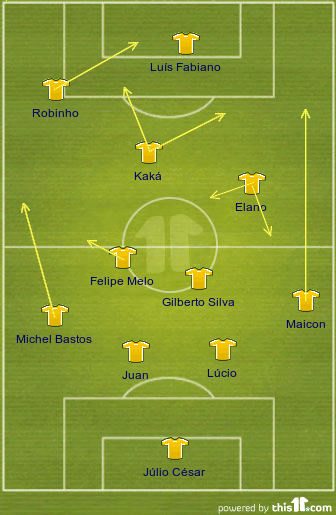
However, the solidity that this provides in the centre of the park serves as a foundation for other more exciting possibilities to emerge going forward. Robinho and Kaká will roam to their hearts' content behind Luís Fabiano, who himself will switch between channel-running and target-man functions. In addition, both Maicon and Michel Bastos are likely to do more attacking than most teams' wide midfielders; the former in particular will be one of the team's primary attacking threats down the right. This is where Elano comes in. Although posted as the right-sided attacking midfielder, the Galatasaray man will shift between that role and a more defensive one, depending on whether Maicon is next to Lúcio in defence or completing another lung-bursting break on the wing.
In the Confederations Cup, it was Ramires who started on the right, a role he performed admirably. Why, then, the recall of Elano? There are, I think, two main reasons. Firstly, and most importantly, Elano's experience makes him more disciplined than Ramires. The Benfica player is a fabulous athlete, part of whose oeuvre is to mount pacy attacks and stretch play down the wing. This role on the team's right, however, is already carried out by Maicon, and Ramires' youthful abandon may leave the team exposed. Elano, not blessed with great pace, is more happy to construct from deeper, thus leaving him in a better position to muck in with Gilberto Silva and Felipe Melo when Brazil lose possession.
The second reason is that Elano provides an excellent option at dead-ball situations; his corners provided a number of goals in qualification. Elano probably won't be the only contender for the seleção's set-piece duties; the side is blessed with an abundance of excellent options. Each one of Maicon, Dani Alves, Michel Bastos, Kaká, and Gilberto (the Cruzeiro left-back) has plenty of experience at club level, and will be vying for an opportunity to stake their claim. Considering also the aerial ability of Lúcio, Juan, and Felipe Melo, Brazil will cause substantial problems from dead-balls.
The Brazil substitutes bench stands as a monument to the fixity of Dunga's convictions. For each player in the starting XI, there is a ready made substitute for the exact role in the formation. Nippy striker who can drift wide or threaten centrally, like Robinho? Nilmar. Powerful but deadly striker, like Luís Fabiano? Grafite. Attacking midfielder who surges forward, like Kaká? Júlio Baptista(!).
This could be either a masterstroke or a colossal error. On the positive side, it should ensure that team cohesion is maintained even when the personnel changes through injuries or fatigue. But the danger is that there are no players who could offer the chance to alter the tactics drastically if necessary; no Ronaldinho to play as creator from the left, no classic playmaking No.10 like Diego (Kaká can dominate games, but more often through his goals and powerful running than with intricate passing).
The two players in the squad who could offer something substantially different from within the role that Dunga seems to have assigned them are the aforementioned Ramires, and Kléberson, who would be a more creative presence in one of the deep midfield roles. The Flamengo man, however, has not seen a minute of friendly action and will probably need a cushion to make bearable the amount of time he'll be sat on the bench in South Africa. Dunga will have to hope that the tactics he has honed since taking charge stand up to scrutiny, because there doesn't look to be a tried and tested plan B on the table.
Form and Injuries
In terms of injuries, Brazil have two minor concerns. The first is over Júlio César, who went off in the game against Zimbabwe nursing a back injury. By all accounts this was a precautionary measure, and reports suggest that the Internazionale goalkeeper should start against North Korea on Tuesday. Secondly, some lingering doubts remain over the fitness of Kaká. The No.10 came through the warm-up games unscathed and will certainly start against North Korea, but may struggle with so many games in a short period, having not had the game time that he might have expected in recent months. Expect him to be withdrawn if Brazil are cruising in a group game.
Surveying the form of the group, the outlook is generally rosy despite one or two worries. Lúcio, Júlio César, and Maicon were superb in Inter's treble-winning season; Robinho and Luís Fabiano have been among the goals, even if not quite at the pinnacle of their abilities; and Juan, Elano, and Gilberto Silva have had moderate seasons. Michel Bastos has shone on-and-off for Lyon, but will have to work on his defensive play in South Africa after some slack positioning in the friendlies. Kaká has admitted to not being at his peak since returning to fitness, but showed signs in the win against Tanzania that his best form may be just around the corner. The principle concern, however, is over Felipe Melo. The midfielder endured a torrid season with Juventus, a shadow of the player who was so dominant in the Confederations Cup.
Verdict
With such a wealth of talent, the job of Brazilian coach can sometimes look an easy one. You just tell Kaká, Luís Fabiano, Maicon, Lúcio, and Robinho to go out and play, right? Dunga thinks not, and is to be commended for constructing a tactical system that allows expressive football within the bounds of a disciplined and balanced formation. If Kaká can rediscover the verve of previous seasons (and as the team's fulcrum, the pressure is on him to do so), it's hard to see Brazil failing to reach the final. Despite the likelihood of a strong challenge from Spain, I predict that Dunga's men will indeed win Brazil's fifth title.
Qualifying/Confederations Cup
A first place finish in the CONMEBOL qualification region betrays the fact that Brazil endured a somewhat shaky route to South Africa. At home, the seleção's form was solid, if rather...well, un-Brazilian. With four goalless draws (from nine fixtures), Dunga's tactics (of which more later) at times drew substantial derision from fans and critics accustomed to a bit more flair. Despite losing at altitude in Bolivia, the side impressed more in away fixtures, romping to exciting wins in Chile, Uruguay, Venezuela, and most tellingly, Argentina, where Luisão's opener and a typically deadly Luís Fabiano double downed Maradona's men. Qualification was secured with a couple of games to go, and the side duly took its foot off the pedal with the loss to Bolivia and a home draw to Venezuela.
Perhaps a more suitable yardstick for judging Brazil's form is last summer's Confederations Cup, a competition which Dunga's men deservedly won. Winning every one of their five games, and scoring fourteen goals (including three against reigning world champions Italy), the seleção demonstrated the kind of ruthless tournament form that places them among the favourites in South Africa.
The Manager
The career of Carlos Caetano Bledorn Verri seems inextricably tied to fairytales. It was his likeness with one of the Seven Dwarfs that earnt him the nickname Dunga (Dopey in the Portuguese version), and in South Africa, the coach of the seleção will be hoping that the World Cup completes the second mythical happy ending of his involvement with the national side. The first came in 1994, when Dunga, a defensive midfielder oft-criticised for his technical limitations lifted aloft the World Cup trophy at the Pasadena Rose Bowl, having captained Brazil to their fourth title.
It was this victory of dedication over ability, of nurture over nature, that Dunga will hope to emulate in South Africa. Dunga the manager, too, has endured objections; both to his tactical set-up (of which more presently) and to his downright stubbornness in the face of public opinion. In Brazil, a country of 190 million 'managers,' some of his decisions (e.g. his dropping of Ronaldinho, his refusal to call up Paulo Henrique Ganso) have been met with howls of consternation and calls for his head to roll. Dunga, however, has barely batted an eyelid. Loyal to his chosen players and to his system, he has thusfar been more than equal to the task at hand; securing qualification, and winning the Copa América and Confederations Cup. If he can lead Brazil to glory in South Africa, he will be saluted (even if reluctantly be his chief detractors) as an idol of the national game.
Tactics
Although some of the criticisms aimed at Dunga regarding his functional tactics are fair, the seleção will undoubtedly be one of the most exciting sides to watch in South Africa. A modest defence of Dunga's tactics is therefore in order. He has settled on a variation on a 4-2-3-1 formation (see below), with Elano, nominally on the right-hand side of the three, often tucking in when Maicon rampages forward from right-back. One of the most noteworthy elements of the formation is the employment of two deep midfielders with a mainly defensive remit; Gilberto Silva and Felipe Melo (although the latter has some licence to occasionally roam forward, as he did with great effect against Peru last year). This move strikes some as too defensive, and is exacerbated by the fact that neither player is a particularly fluent passer; critics may accept two deep-lying midfielders if one was in the mould of, say, Andrea Pirlo.
However, the solidity that this provides in the centre of the park serves as a foundation for other more exciting possibilities to emerge going forward. Robinho and Kaká will roam to their hearts' content behind Luís Fabiano, who himself will switch between channel-running and target-man functions. In addition, both Maicon and Michel Bastos are likely to do more attacking than most teams' wide midfielders; the former in particular will be one of the team's primary attacking threats down the right. This is where Elano comes in. Although posted as the right-sided attacking midfielder, the Galatasaray man will shift between that role and a more defensive one, depending on whether Maicon is next to Lúcio in defence or completing another lung-bursting break on the wing.
In the Confederations Cup, it was Ramires who started on the right, a role he performed admirably. Why, then, the recall of Elano? There are, I think, two main reasons. Firstly, and most importantly, Elano's experience makes him more disciplined than Ramires. The Benfica player is a fabulous athlete, part of whose oeuvre is to mount pacy attacks and stretch play down the wing. This role on the team's right, however, is already carried out by Maicon, and Ramires' youthful abandon may leave the team exposed. Elano, not blessed with great pace, is more happy to construct from deeper, thus leaving him in a better position to muck in with Gilberto Silva and Felipe Melo when Brazil lose possession.
The second reason is that Elano provides an excellent option at dead-ball situations; his corners provided a number of goals in qualification. Elano probably won't be the only contender for the seleção's set-piece duties; the side is blessed with an abundance of excellent options. Each one of Maicon, Dani Alves, Michel Bastos, Kaká, and Gilberto (the Cruzeiro left-back) has plenty of experience at club level, and will be vying for an opportunity to stake their claim. Considering also the aerial ability of Lúcio, Juan, and Felipe Melo, Brazil will cause substantial problems from dead-balls.
The Brazil substitutes bench stands as a monument to the fixity of Dunga's convictions. For each player in the starting XI, there is a ready made substitute for the exact role in the formation. Nippy striker who can drift wide or threaten centrally, like Robinho? Nilmar. Powerful but deadly striker, like Luís Fabiano? Grafite. Attacking midfielder who surges forward, like Kaká? Júlio Baptista(!).
This could be either a masterstroke or a colossal error. On the positive side, it should ensure that team cohesion is maintained even when the personnel changes through injuries or fatigue. But the danger is that there are no players who could offer the chance to alter the tactics drastically if necessary; no Ronaldinho to play as creator from the left, no classic playmaking No.10 like Diego (Kaká can dominate games, but more often through his goals and powerful running than with intricate passing).
The two players in the squad who could offer something substantially different from within the role that Dunga seems to have assigned them are the aforementioned Ramires, and Kléberson, who would be a more creative presence in one of the deep midfield roles. The Flamengo man, however, has not seen a minute of friendly action and will probably need a cushion to make bearable the amount of time he'll be sat on the bench in South Africa. Dunga will have to hope that the tactics he has honed since taking charge stand up to scrutiny, because there doesn't look to be a tried and tested plan B on the table.
Form and Injuries
In terms of injuries, Brazil have two minor concerns. The first is over Júlio César, who went off in the game against Zimbabwe nursing a back injury. By all accounts this was a precautionary measure, and reports suggest that the Internazionale goalkeeper should start against North Korea on Tuesday. Secondly, some lingering doubts remain over the fitness of Kaká. The No.10 came through the warm-up games unscathed and will certainly start against North Korea, but may struggle with so many games in a short period, having not had the game time that he might have expected in recent months. Expect him to be withdrawn if Brazil are cruising in a group game.
Surveying the form of the group, the outlook is generally rosy despite one or two worries. Lúcio, Júlio César, and Maicon were superb in Inter's treble-winning season; Robinho and Luís Fabiano have been among the goals, even if not quite at the pinnacle of their abilities; and Juan, Elano, and Gilberto Silva have had moderate seasons. Michel Bastos has shone on-and-off for Lyon, but will have to work on his defensive play in South Africa after some slack positioning in the friendlies. Kaká has admitted to not being at his peak since returning to fitness, but showed signs in the win against Tanzania that his best form may be just around the corner. The principle concern, however, is over Felipe Melo. The midfielder endured a torrid season with Juventus, a shadow of the player who was so dominant in the Confederations Cup.
Verdict
With such a wealth of talent, the job of Brazilian coach can sometimes look an easy one. You just tell Kaká, Luís Fabiano, Maicon, Lúcio, and Robinho to go out and play, right? Dunga thinks not, and is to be commended for constructing a tactical system that allows expressive football within the bounds of a disciplined and balanced formation. If Kaká can rediscover the verve of previous seasons (and as the team's fulcrum, the pressure is on him to do so), it's hard to see Brazil failing to reach the final. Despite the likelihood of a strong challenge from Spain, I predict that Dunga's men will indeed win Brazil's fifth title.
Subscribe to:
Posts (Atom)